Ken Black has started building resources here with an Ethiopian version of STEP and an amharic translation of the Inclusion spectrum.
Now Tilahun has begun drawing some of the games the coordinators use. Note the notes in Amharic.


Ken Black has started building resources here with an Ethiopian version of STEP and an amharic translation of the Inclusion spectrum.
Now Tilahun has begun drawing some of the games the coordinators use. Note the notes in Amharic.
Sport for Development is something that is deemed essential when working internationally, as sport is the medium through which so many messages can be carried. Leadership; values; empowerment; roles and responsibilities; inclusion; competition; methodical preparation, even strategy. All can be carried through the wonderful medium of sport, and the examples can be delivered in the short, medium and long term.
One of the interesting factors in working internationally is the influence of culture on all of the above. I am in Ethiopia at the moment, and trying to get Ethiopians to explain why they are good at something and how they have developed can be difficult, as there seems to be a deep underlying strand of humility in their cultural form of expression. Sometimes I feel we should be learning from the very people we are trying to influence! I’m not sure the reciprocity of development is always emphasised enough?
Sport for development is also used within the UK, but it isn’t always given that title. The work of the Youth Sport Trust is promoting leadership in young people is absolutely outstanding and it has to be world leading and absolutely world class provision. From very young people leading activity in the playground to national conferences with outstanding young role models in coaching, officiating and performing. The Youth Sport Trust embeds the development leadership by young people at its very core.
Most sport has an inherent aspect of development … The debate to be had is whether development should always be its main focus?
I went to Gondar today, 3 hours each way by minibus. The minibus is the ultimate utility vehicle … carrying up to 20 people … (seats for 13!) it picks people, parcels, crops, chickens and drops them at any place on the road. The whole system is simple, well run and very friendly and caring. Pics of Gondar 17th century castle.


Part of the focus for the next year’s work in Bahir Dar is building training expertise. Here is Tilayun the Project Coordinator running a session on festival organisation.
He did a brilliant job!!


The Cheshire Foundation workshop here also makes hand trikes. Alemeyeu has been playing with a new design. Here you see him pictured with Mohammed the Regional Coordinator and his assistant. Alemayeu is one of the most inventive people I have met!!


Well … the coordinators got to grips with putting up and taking down the net today. We all had great fun and discovered in can be put up in just 27 seconds. Brilliant … And it is lighter than the one from the UK … next challenge … How to carry it on a bike!!


I was asked by one of the IN staff to think about what lessons I would take home with me … It’s another great question!
I have taught most of my life 19 years in schools, 11 in University and of course I was always aiming for transformation. The lesson I have learned here is that training needs to be on several levels. Yes … It has to have content, but it also needs to have interpretation for implementation. The trainer must always be aware of the context and situation of the person receiving the information and how they are expected to use it. The people here have had wonderful content about inclusive activity, but they also need help in how to break down barriers, how to work with teachers in schools, how to keep motivated, how to ensure they measure the impact of what they are doing, so for every part of content, the other things have to be delivered in equal measure. I am working on a similar project in the UK and now have a much better understanding of how to proceed. Thanks to International Inspiration for giving me the opportunity.
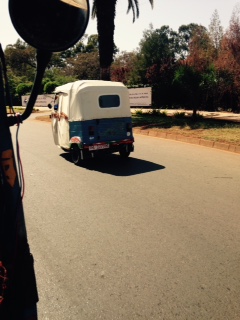
The Bajaj is a universal form of transport in Bahir Dar. They seem to be on the roads for 24 hours and whenever you need one it is there. People here share them so they are wonderfully economical and I’ve seen up to 4 people + driver sitting in them comfortably. The driver usually carries a water bottle filled with petrol in case he runs out!! Typical fare for a 2.5km ride is 15-20 birr 50-60p. They are based on a scooter, hence the handlebars, and have 3 wheels … To go backwards in a 3 point turn you have to push. I love them!!


Fekadu one of the coordinators is brilliant at making up games. Here he is playing a colour recognition game while teaching the signs to a girl who has a hearing impairment.

It is wonderful to see Polybat being played in Ethiopia. This girl had severe movement difficulties before CF-AI and the coordinators arrived. Now she’s making a rally in Polybat!!
